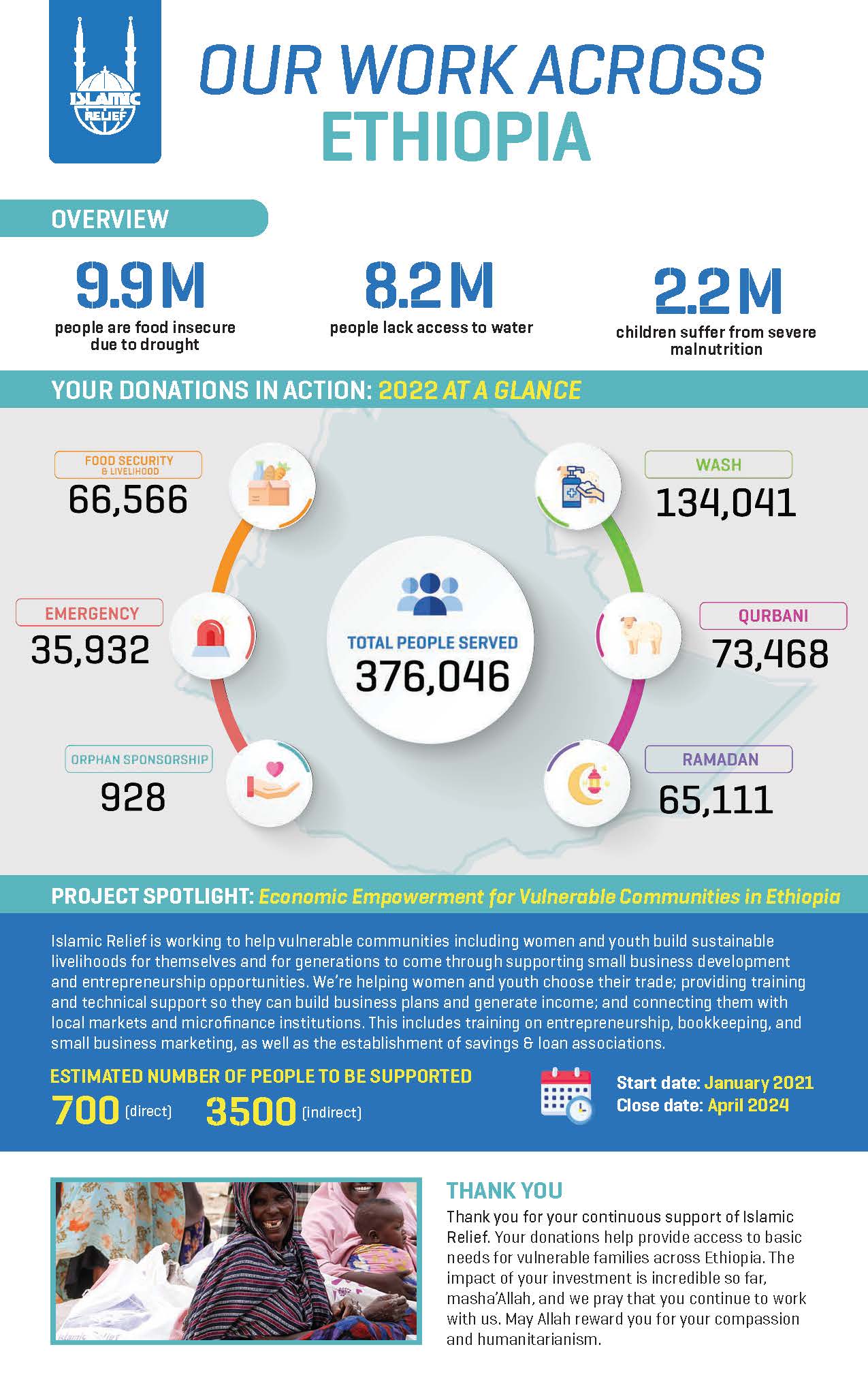
Ethiopia_Web

Ethiopia

About the Situation

By the Numbers

More than 91,000,000 people live in Ethiopia

29% of the people in Ethiopia live below the poverty line

31% of the population does not have access to safe drinking water

(Sources: U.N. and U.S. government)

Although acute droughts wreaked havoc on Ethiopia’s economy in the first few years of the millennium, the country has made significant economic progress since 2003. Government aid programs have alleviated poverty levels in rural areas; however, urban poverty has increased.

Ethiopia’s economy and poor population are extremely vulnerable to external forces such as climate-related changes and increasing global food prices.

How Islamic Relief is Helping

Islamic Relief™ launched operations in Ethiopia in response to severe droughts in 2000, 2001 and 2002. After years of emergency relief efforts in Ethiopia, Islamic Relief Ethiopia opened in January 2004. Relief teams have implemented long-term development projects that have improved access to education, health care, water and sanitation. Islamic Relief also launched several projects aimed at developing livelihood and food security, and strengthening the capacity of local organizations. Ethiopia was also one of several African countries supported by Islamic Relief’s Africa Food Crisis campaign.

Here’s a breakdown of some programs Islamic Relief has supported in Ethiopia:

ORPHAN SUPPORT & SPONSORSHIP
On going

RAMADAN FOOD DISTRIBUTION
Seasonal

UDHIYAH/QURBANI DISTRIBUTION
Seasonal

EMERGENCY LIVESTOCK INTERVENTION PROGRAM
Completed

This program introduced more than 38,000 people in the community of Afar to new approaches to livestock health services. Local animal health care workers were trained on best practices, and vaccinations and treatments were administered to help safeguard animals from disease.

EMERGENCY RESPONSE, INCLUDING FOOD AID AND WATER PROJECTS
Completed

Islamic Relief was on the ground in Ethiopia (as well as in Kenya and Somalia) to provide vital aid to survivors of the 2011 drought—considered the worst drought to hit the region in 60 years. More than 40,000 people in Ethiopia received emergency aid through efforts including supplementary food provisions for malnourished children and water truck services for tens of thousands of individuals.

INTEGRATED LOCAL AREA DEVELOPMENT
Completed

Islamic Relief worked to improve the health, education, water and sanitation services for 22,000 people in the Hargele, Cherati and Elkere districts over the course of three years, ending in 2013. The program helped strengthen the health management information system of district health offices; support the distribution of promotion materials on health awareness; enhance co-curricular activities for students through the establishment of school clubs and competition initiatives; train individuals on water schemes management; and much more.

HOW YOU CAN HELP

Participate

by organizing and attending local fundraisers that support IRUSA’s efforts.

Advocate

by sharing information about IRUSA’s efforts with your social media networks.

Donate

to the Ethiopia Humanitarian Aid fund to support efforts like these.